Wednesday, 30 March 2011

The Classics Circuit - Tender is the Night by F. Scott Fitzgerald

I have to admit to total ignorance of what the Lost Generation actually was, until I started to do some research as background to reading Tender is the Night . I’ve read a fair amount of English literature over the years, but not so much American. Pretty much the only author I’d read from this generation is Eliot, because he’s also classed as English Literature. Following on from this tour, many of the Lost Generation will join the ever-expanding TBR list. People who have participated in, or been keeping up with the tour (or who are just more educated about American literature than I am, which is not hard. English literature, I’m great at. American, not so much...) will know all about it, so I won’t reiterate, but just say thanks to  Rebecca for giving me the chance to learn about it, as well as to finally read a book that’s been sat on the shelf for literally years!
The idea that stuck with me as I read the novel , was that many of the writers of this generation had left America, in pursuit of artistic freedom and new experiences. To me, the word ‘lost’ in particular implies something in transmission, waiting to be found, to define itself. The generation who fought in the war were often either physically lost, through death or injury, or else lost in the new structure of society. Tender is the Night  felt like it was lost, drifting, trying to find its way home... There is a lot of power in the fragmented style of the novel, and, for the first time in almost three years, I finished the book and immediately wanted to go back and read it again, as I know that there was a lot that I missed. It also immediately threw me back to an excruciating course on Modernism that I took at university - just to give you an idea, Ulysses and The Waste Land were required reading. I don’t know too much about American literature, and because of this Modernism, primarily a European movement, with its emphasis on finding new forms of expression, and discussion of the change and breakdown of society and social structures, was the thing that immediately leapt to mind when thinking about the post – war years. Despite being part of this specific American generation of writers, Tender is the Night fits well into the Modernist tradition, particularly for it’s’ denial of previously accepted absolute truths such as love and marriage, and emphasis on the temporary nature of everything, from money, to love, to sanity itself.
Previous to reading this, my only experience of Fitzgerald was of falling in love with The Great Gatsby while at college. When I first started Tender is the Night , I was worried that the Gatsby love was just a fling, brought on by my first experiences of a proper academic library, combined with my first forays into the world of literature proper, but after a while I realised that, no, I actually just love Fitzgerald’s style.
Tender is the Night was F. Scott Fitzgerald’s final novel, and it reads as if it were a goodbye. It is, as many people have noted, basically an autobiography of the Fitzgerald marriage – Zelda Fitzgerald was hospitalised with schizophrenia, just as Nicole Diver is in the book, and Fitzgerald himself had problems with alcohol, as does Dick Diver.
It focuses on Dick Diver, a psychiatrist, and his wife Nicole, whom he first meets as a schizophrenia patient at a clinic in Zurich. Their relationship is the crux of the novel, and is expanded through the people that they surround themselves with. It shows very clearly, the almost bipolar extremities of the Divers’ relationship. In the beginning, Dick feels that he can protect Nicole; from the world, her past, herself. She needs holding together, and he is the one to do that. However, throughout the novel the dynamic of the relationship changes. Dick has affairs, most especially with Rosemary Hoyt, an actress, and Nicole, to some extent, allows this, but as the story progresses, and Nicole regains her sanity and strength, the dynamic changes, as she becomes the one to leave him. A lot happens during the course of the novel, but at the same time, not much: a duel, a murder, incest, affairs, marital breakdown, police brutality, and mental illness, are all part of its makeup, but still the story remains down to earth, rather than sensational, detached from reality, while all the time having a feeling of truth and relatibility about it.
I personally loved the way that the fragmented structure and style related to the cycles of sanity and insanity in the story. It begins in a coherent manner,  told through the eyes of Rosemary Hoyt, an actress, whom the Divers take into their ‘set’, and it is her impression of them that we’re first given. The second part of the novel jumps back in time to tell the story of Dick and Nicole, and Nicole’s breakdown becomes apparent in the breaking down of sentences and though patterns towards the end of the second part. As the book begins, Nicole is fragile, and unable to differentiate the real from the false , but as she manages to find her sanity, and break free from Dick, he descends increasingly into alcoholism and depression. One of the things that I really enjoyed, was that despite the central character being male, I really felt like the women won out in the end. Tender is the Night  seemed to me to be a book which showed the strength of women. One of my favourite passages was fairly early on in the book:
“Their difference from so many American women, lay in the fact that they were all happy to exist in a man’s world – they preserved their individuality through men and not by opposition to them” p45
At this point in history, where a woman’s role was fairly much still defined by men, especially if she was married, Fitzgerald is granting his women the privilege of existing within a male dominated world, but as individuals, rather than just as ‘wives’. The central story of the novel is Nicole’s regaining of her identity, and independence. At the end of the novel, Nicole is the strong, victorious one, and Dick, whose brilliance as a doctor is gone on and on about, throughout the story, fades into obscurity. The last lines of the novel are:
"in any case, he is almost certainly in that section of the country, in one town or another”p274
A few things I disliked, just to even it up, were how shallow most of the characters were, although I do appreciate that this is part of the society Fitzgerald is trying to represent. I also was annoyed by the fact that Nicole only left Dick in the end, because there was another man around who she knew loved her, and not because she had actually gained any real independence or ability to be her own person. That may just be the slightly ranty feminist in me coming out, though.
I often feel that many other bloggers think and process what they are reading much more than I do. Like, my brain got me through 3 years of university, and then just gave up and died. Reading Tender is the Night made me feel like it had come alive again. I actually immersed myself in it, I read slowly, trying to take in every single word (I’m usually a terrible skimmer!), I revelled in all the natural scenery; the sea, the mountains, the vivid imagery, and I loved every single second, from about page 40 onwards.
Having read Booksploring’s  review of Zelda Fitzgerald’s Save Me The Waltz, I think that this will have to be my next read!

Tuesday, 29 March 2011

Affinity Readalong: Post 1

I'm reading this book as part of Andi's Affinity Readalong
Because I signed up for the Classics Circuit Lost Generation Tour, and got all absorbed in Tender is the Night, I didn't think I'd finish the first two parts of Affinity in time - I still hadn't started it by Friday night, and had to work all day Saturday! But it says a lot for the characters and atmosphere Sarah Waters has created, that I've not only hit the deadline, but can't wait to find out more!

I've had this book on my shelf for around 3 years. I read The Night Watch, fell in love with it, bought this, and never read it, until now. So far, I'm in love with it! It took a little while to get into it, because at the beginning, it's very jumpy, and it isn't always easy to tell who is talking. Also, the beginning is full of references and allusions to events, without really explaining anything, but after Margaret Prior started to visit Selina Dawes, it really started to become engrossing.

I love the prison setting, and it's really interesting to find out the kinds of things people would be sent to prison for in this period (4 years for procuring an abortion...?!). Also, it reminds me (in tone, and content) a lot of many of Sarah Rayne's books, which I adore. At the moment, I'm most interested to find out how much of the spiritualism side of things, is actually just tricks, and the details of what happened to get Selina put in jail. I'm also keen to know Margaret's story in full, rather than as hints and mystery. At the moment, I'm concentrating so much more on the story, so I'll be able to comment much more fully on the style, and dissect the book more, when I finish, which will probably be in about a day! This book is awesome!!

Wednesday, 23 March 2011

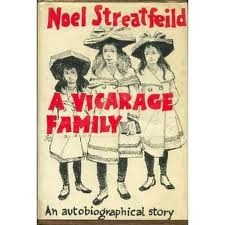
A Vicarage Family by Noel Streatfeild

Yay, the writing bug is back! :-) It feels like ages since I last reviewed anything, so last night I sat down and wrote this, and I'm sooooo glad I did. The sun is shining, I'm excited about reviewing books again, all is right with the world. So, this is the latest update on my Noel Streatfeild Challenge. I'm having a lot of fun with this so far, and really enjoying starting to read some of her books that I haven't before! The copy of A Vicarage Family which I got from the library was a mega old one, first borrowed in the 1970s. Interestingly, it was borrowed consistently throughout the '70s and '80s, but then only three times between 1993 and 2011. I guess it's representative of the decline in Streatfeild's popularity... and it's a shame. Anyway, on to the review!

A Vicarage Family is the first part of Noel Streafeild's autobiography. She says that she has changed the names, because it is only the truth as she remembers it, and acknowledges that it may not be the truth as it actually was. It follows the Strangeway family - the father is a vicar, and the novel documents the childhood of the Strangeway children, Isabel, Victoria (Noel), Louise, Dick, and their cousin, John.

I really enjoyed the novel. I've enjoyed all of Streatfeild's work, so far, but I liked this on a different level. Victoria is instantly recognisable as the awkward middle child, who just doesn't seem to be able to get anything right, and whose attitude and problems with authority are constantly causing her to get into trouble. In her, I can see where Streatfeild got the ability to create such characters as Jane Winter (one of my favourites..) in The Painted Garden : children who feel untalented and unloved, and so become products of an environment where their siblings are constantly favoured and prioritised above them. 

The book had all of her usual charm and comfortable feeling about it, but it was much more gritty than I'm used to - for the first time, the First World War actually left its mark on the book, rather than just passing over or around it. Even books like When the Siren Wailed, which is ostensibly about the war, didn't really feel like they engaged with it as much as this novel did, and for me, that took it to a completely different level.

Having read this, I'm starting to see similarities to different parts of all her other novels, and maybe it's the authentic touch of reality which is what I love about Streatfeild. Her books often feel like my own childhood. The book was published in 1963, well after the success of Ballet Shoes, etc, so in some ways I suppose it can be seen as a kind of explanation of her children's books.

I'm starting to think the first book I read when embarking on this challenge, should have been a biography of Streafeild. When I was at university,a  few professors used to tell us that for every new author we read, we should read a biography, as understanding the author's life experiences and their historical period, often helps to better understand their work. I really wish I had enough hours in the day to be able to fit in reading a biography of every author I read, especially the ones I love, but realisitically, given my huuuuuuuge TBR pile, plus the fact that I do have a job, and a life outside of reading a blogging (ish, anyway!), a house to clean, and friends who expect me to at least vaguely keep in touch with them, it's not going to happen. So, for the moment at least, I'm stuck with reading author bio's on Goodreads and Wikipedia, and from the introductions in books. Reading A Vicarage Family helped give me at least a little bit of insight into Noel Streatfeild, and what caused her to write in the way that she did. I am planning to read the other 2 installments of her autobiography, as and when the library get them in for me, and I'm also planning to read a biography, just to see if somebody else's view of her life even slightly tallies up with her own!

Rating: ****
(I've decided I give out too many 5 star ratings, so I'm stopping. Unless they actually are earth-stoppingly good. This was great, but the earth kept turning....)


Monday, 21 March 2011

Monday Spotlight 2: Anastasia, At Your Service by Lois Lowry

As a teenager, I read a lot of Lois Lowry. Nobody else I knew did. Mind you, not many of my friends at that age actually read much at all! But despite this, I've never read The Giver, which is the Lowry book which appparently is some kind of a rite of passage for loads of other people. Since I've been thinking about books I want to reread for the spotlight on childhood favourites, I'm starting to think I should expand it to include books I should have read as a child, but never got around to, such as The Giver, and Rebecca of Sunnybrook Farm, among others.

Anyway, as you may have seen, I was bought an awesome load of books by my boyfriend for our anniversary, which included 3 of the 'Anastasia' books I loved as a twelve and thirteen years old, and which, I must admit, I've not seen anywhere pretty much since then.
As with the Famous Five last week, Anastasia, At Your Service didnt' disappoint me with the reread. The book was funny and engaging - I will actually admit to giggling a little while reading it.

Anastasia Krupnik (best surname ever by the way) is twelve. Her family have just moved, and she is bored, and needs a job to supplement her allowance. What she really wants to do, is be a companion to a rich old lady, so she writes up a resume, and, with help from her parents, (who never laugh at her!) puts it up in all the places she thinks rich old ladies hang out. This lead to a rich old lady, Mrs. Bellingham, hiring her as a maid (oh, the crossing of wires! Hilarity...) where she meets her grandaughter, Daphne, and makes her first friend.

The things that happen in the book - Anastasia and Daphne plotting to get their revenge on Daphne's grandmother for giving her a doll (shock, horror!) for her birthday, Anastasia's little brother, Sam, falling out a window and ending up in hospital - are all fairly routine things, which really could happen to anyone. When I was twelve, Anastasia's life could easily have been my life. I schemed with my friends like she schemes with Daphne, I talked to my family in the same way as she does hers (convinced I absolutely couldn't survive on the amount of pocket money I got, why did my parents never listen to me, etc, etc, etc), and I tried, and failed dismally, to be 'grown up'. Rereading this book made me remember so many things I'd forgotten about being twelve.

It has a simplicity that I think is lacking in a lot of teenage fiction today, but also which probably stems from the time at which it was published (1982). Nowadays, I can't see many parents letting their twelve year old out on their own until 9pm without a mobile phone, at the very least! The Anastasia books are similar, in tone and content, to The Babysitter's Club books by Ann M. Martin, which were my all-consuming passion between ages 11 - 14, and which I'm hoping to get hold of to reread. Unfortunately, '80s YA seems to be totally out at the moment, making it really hard to get hold of. I could kick myself, as at one point, I had pretty much the entire series that I'd collected from library sales and charity shops, but I passed them on to my sister who was a bit too young for them at the time, and they were all offloaded to some other friend of the family. Now I just wish I'd hung onto them - kept them in a cupboard or something. But I suppose if I start thinking like this, I'll never get rid of another book, ever, and then my house will be overrun...

To conclude, Anastasia, At Your Service is still as simple, funny, and true as I remember it being. I loved rereading it, and now I've got to get hold of the rest of the series!

Friday, 18 March 2011

Books!

Recently, I've been totally terrible at actually writing and posting reviews of all the many books I've been reading. I will get around to it, I promise, just not sure when... I am reading a lot, and really getting excited about things, but writing isn't one of them at the moment. I'm sure it will be again soon.

So to make up for that, I wanted to share a pretty photo I took. I've been on a year long book buying ban since the beginning of February, and I'm doing well so far. So to reward me, for our anniversary, my fiance gave me a £10 limit and bought me some books, and I think I did pretty well for the money! Here's what I got:


From top to bottom:
  • The BFG by Roald Dahl - I've recently started a project to re-read all my favourite books throughout my childhood and teenage years, and had to get this when I found it while searching in a charity shop.
  • Reading Lolita in Tehran by Azar Nafisi - Since reading Persepolis, I've got really interested in literature about Iran, and as this is a memoir about the reading of books, and censorship, both things I'm really interested in, it was another 'had to have'.
  • The Help by Kathryn Stockett - I had this on order from the library, but there are about 300 reserves on it, so the chances of me getting it before next year were minimal. Buying it just seemed to make sense. 
  • Rabble Starkey by Lois Lowry - For the re-reading project. I used to have a copy of this I bought from the library for about 10p, but it's been lost or given away or nicked by one of my siblings, so now I have another one!
  • Anastasia At Your Service by Lois Lowry - Again another one I loved as a kid. This (and the other two I got) are just books I'd totally forgotten about, and when I found them today I went into a little bit of a squealy fit (no, I'm not proud..) and had to have them. It helped that they were only 99p each!
  • Anastasia Has the Answers by Lois Lowry
  • Anastasia's Chosen Career by Lois Lowry
  • Bel Canto by Ann Patchett - I've been hearing and reading really good things about this for ages now, and it's a really nice copy. I'm definitely excited to read it!
Now I just have to find shelf space for them, wish me luck!! 

Wednesday, 16 March 2011

The Three Musketeers Readalong : Part 1

I've wanted to read this book for a long time, so when I found out about the readalong, I had to join in! As a child, I remember watching loads of adaptations of The Three Musketeers. In the first 29 chapters, though, everything I remember happening in the animated children's series, has already happened, so I'm really interested to see what happens next!

When I started reading, I really didn't think I was going to like the characters at all. D'Artagnan in particular, came across as a bit of a self-important, oversensitive child, and all of them really, seemed overly ready to draw their swords for the smallest percieved insult. Within about ten minutes of being in Paris, D'Artagnan managed to offend, and thus end up engaged to duel, each of the Three Musketeers, Athos, Porthos, and Aramis. When they are attacked by the Cardinal's guards, D'Artagnan steps up to help the musketeers, after which they take him on as their protege, and somewhere along the line, I started to like him. His self-importance became determination, oversensitivity, romanticism, and the desire to duel with everyone has turned into a really quite touching bravery, and desire to defend and protect his friends. I do feel that so far, a lot of the time, D'Artagnan comes across as a boy, pretending to be a man.

I've only been reading this two chapters a day, and to be honest, I think that's probably what's keeping it fresh for me. There have been days when I've wanted to read lots more than two, and equally days where the two have seemed like an impossible chore, although there have definitely been less of these! The only other Dumas book I've read is The Count of Monte Cristo, which is an absolutely huge, beast of a book. I really enjoyed it, but I (and my sister) both did manage to skip a fair few chapters in the middle where not much was happening, and pcik it up again at the end, not having missed much. So far with The Three Musketeers, I'm wanting to stick with it all the way through, for the most part.

Like a lot of people, though, I'm finding it hard to get to grips with the terrible lack of morals the musketeers have. It's equally hard to balance this lack of morals, with the kind of religious scenes which run through the book. The chapter about Aramis' thesis was the one I found hardest to get through, so far.  I do feel, though, that the novel is much more about the characters than the setting, and, for me, the two haven't really connected yet. It may sound like a silly thing to say about a novel that's so specifically French, but to me, the setting just hasn't really come alive. Thankfully, the adventure side of the story totally makes up for any of the things which are lacking.

I'm really looking forward to finding out what happens in the last half of the book!

Monday, 14 March 2011

Monday Spotlight: Enid Blyton

When organising my bookshelves this past weekend, I started unearthing some books I adored as a child. Obviously, this led to me being sat cross legged on the floor for a fair few hours in raptures, remembering more and more books I couldn't possibly live without as a child. Hence, a new weekly feature. Each week, I'll talk about a book or author I loved as a child, and ask for other people's favourites and opinions. Despite the fact that I read a LOT as a child, I still feel there was lots I missed out on! Basically, this just gives me a kind of validation to read children's books! I'll try to post on Monday, or as close to it as I can, every week.

So, for the first week, the queen of children's books when I was around 8: Enid Blyton. Because writing about Blyton is such a task (she's estimated to have published about 800 books over a 40 year period - that's 20 books a year!) I'm going to break it down by series. First series, The Famous Five. And my absolute favourite of all was Five Go Off in a Caravan.


The first thing that struck me, on my re-read, was how sexist the books are! Anne's (the youngest) biggest excitement about being allowed to go on a caravan holiday by themselves, is that she'll have two caravans to clean 'all by herself'. Her mother then says that of course George (another girl) must help her, and probably the boys will too, which Anne answers by saying that the boys wouldn't know how to cook or clean anyway!This made me slightly angry. My parents are Catholics, and have always been slightly 'traditional' about gender roles in the home, but as kids my brothers were taught to cook and clean up after themselves, and household chores were always evenly distributed, regardless of gender.

Aside from teaching children that women's roles are in the home, which, to be fair, they pretty much were at the time the book was written, I actually loved this as much as I remembered.
It had all the suspense I remembered, and if the characters were slightly two-dimensional, it was more reassuring than annoying. I loved the fact that the children were always eating, and running around outside, and basically doing all the things I remember doing as a kid. Also, it has a circus in it, which can really only be a plus.

Basically, the Famous Five - George (Georgina), her dog, Timmy, and cousins, Julian, Dick, and Anne, go on holiday (by themselves!) in caravans, and end up discovering the hidey hole of a couple of theives. Of course with much plotting, hiding, drama, and drinking of ginger beer along the way. I always liked The Famous Five more than the Secret Seven, as they were always doing things I wanted to do as a child. I think wish fulfillment is a huge part of children's literature, and I'm looking forward to re-reading more of my Enid Blyton favourites.

How did other people feel about Blyton as children? Any favourites?

Out of curiosity, does anybody know what poltical correctness has changed Dick's name to in the reprinted editions? As they've changed all the children's names in The Magic Faraway Tree, I assume they've done the same with this...